Optimize your formaldehyde production
with LiquiSonic®


Formaldehyde production is an energy-intensive process where the smallest deviations can have a significant impact on quality, costs, and plant availability. With LiquiSonic®, you monitor chemical concentrations inline and in real-time.

Challenges in formaldehyde production

Formaldehyde production places high demands on process management, as even small deviations in methanol oxidation can have noticeable effects on efficiency, product quality, and plant condition. Often, there is a lack of continuous transparency about the actual composition of the liquid product stream, so changes can only be detected with a delay. Fluctuating residual contents indicate declining catalyst activity, while an incomplete or unstable reaction, for example, can lead tothe formation of formic acid. Undesirable by-products and incomplete reactions not only negatively affect formaldehyde quality but also increase corrosion risks and maintenance requirements of the plant.

Since classical laboratory analyses are usually only conducted on a random sampling basis, there is little room for quick and targeted process correction. In practice, this often leads to plants being operated with safety margins – at the expense of energy efficiency, raw material consumption, and cost-effectiveness. At the same time, there is increasing pressure to standardize processes, automate them, and make them independent of the pure experiential knowledge of individual employees.

Discover our solution!


Our solution: The LiquiSonic® Measurement system

Monitor concentration in real-time

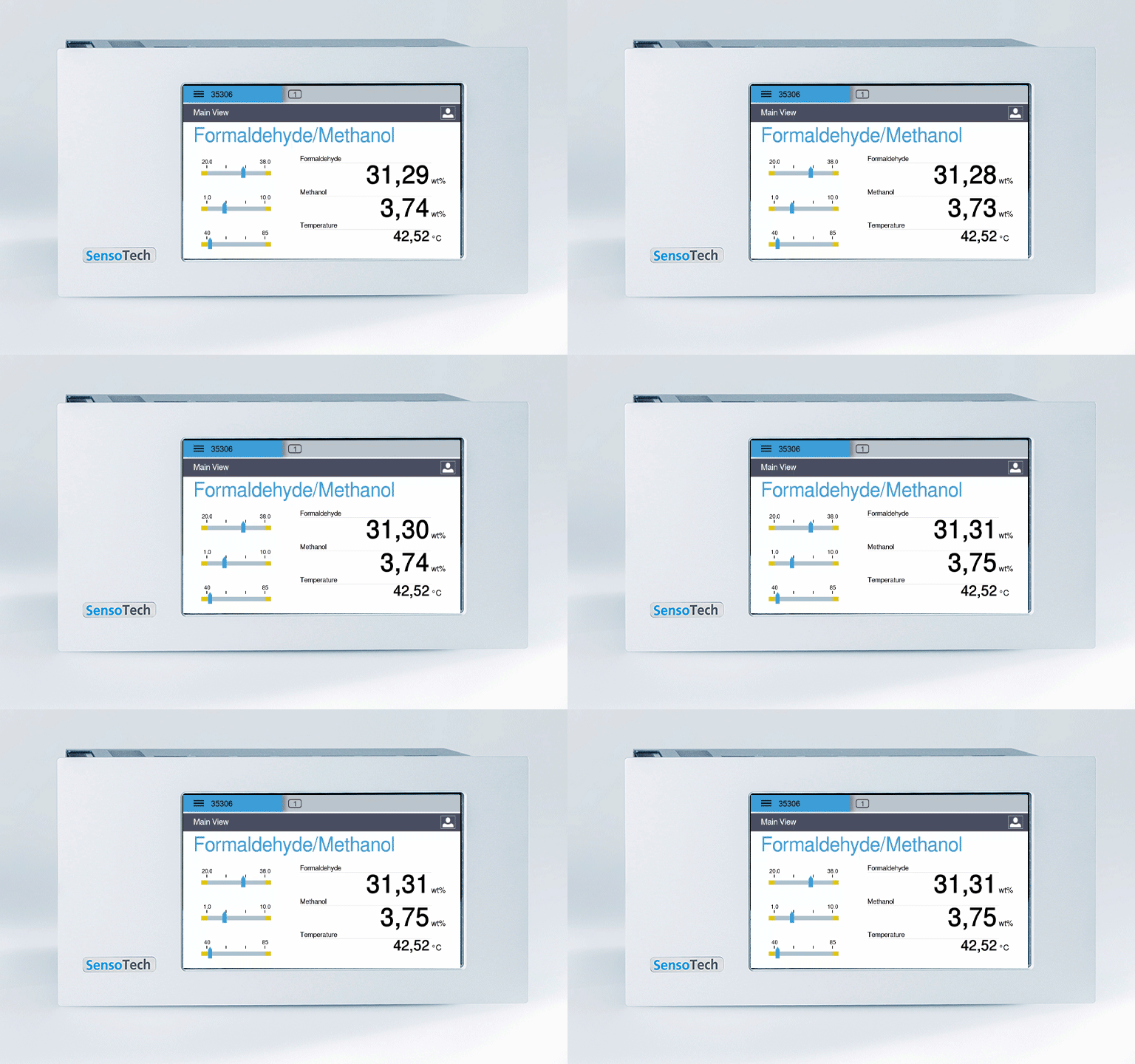
LiquiSonic® enables continuous inline measurement of methanol and formaldehyde concentrations directly in the process. Instead of waiting for sporadic laboratory values, all relevant information is available in real-time. The measurement system combines the measurement of sound velocity and density to detect even the smallest concentration changes with high precision. Thanks to the robust plug-and-play sensor technology, LiquiSonic® is specifically designed for industrial continuous operation in chemical plants. Different sensor lengths, process connectionsas well as digital and analog interfaces enable seamless integration into existing control systems. Process deviations are detected early. This allows reactions to be specifically readjusted, by-products to be minimized, and overall plant efficiency to be significantly increased.

  • Continuous inline measurement
  • Early detection of wear
  • Transparency about reaction completeness
  • Optimization of oxidation conditions
  • Reduction of laboratory, energy, and raw material costs

Technical and economic details

Measuring principle

LiquiSonic® uses the physical property that the speed of sound in a liquid changes with its chemical composition. Each concentration of, for example, methanol, formaldehyde, or formic acid affects the propagation speed of sound in a characteristic way. By combining the measurement of sound speed and density, a unique measurement value for the respective process liquid is obtained. This method is independent of optical properties such as color or turbidity and is therefore particularlyrobust against process fluctuations. Because, among other things, no chemical additives are required, the measuring device is maintenance-free and the measurement is stable in the long term. The calibration is performed once and is product-specific, allowing for very high measurement accuracy. This ensures reliable concentration monitoring directly in the ongoing process.


Economic Benefit

With LiquiSonic®, you reduce energy consumption by keeping the reaction process permanently in the optimal range. At the same time, methanol consumption can be reduced, as overdosing is immediately detected and avoided. Fewer by-products mean higher product quality and lower processing costs. In addition, time-consuming and costly laboratory analyses are eliminated, which relieves personnel and further increases process safety.

  • Reduced Energy Consumption
  • Lower Methanol Consumption
  • Fewer Unwanted By-products
  • Savings on Laboratory and Personnel Costs
  • Higher Plant Availability


Application Example

In an industrial formaldehyde plant, LiquiSonic® is installed directly in the product stream. During ongoing operations, the system continuously monitors the methanol and formaldehyde concentrations. If the residual methanol content exceeds a certain threshold, it is detected early by the plant control system, allowing timely response. In parallel, the measurement signal enables proactive process monitoring, allowing deviations to be compensated early. This prevents an incomplete reaction andthe resulting formation of formic acid is avoided. By specifically adjusting temperature, air supply, or residence time, the reaction is now stabilized. The result: Consistent product quality, fewer unwanted by-products, and significantly extended service life. The customer additionally benefits from higher plant availability and lower operating costs.


Success stories and references:

You can obtain detailed case studies and customer references from our sales team. Feel free to contact us for specific application examples!

The main advantages at a glance


Transparency in the process

Continuous inline measurement provides immediately usable data without delay.

Sustainable cost reduction

Lower energy, chemical, and laboratory costs through optimized process management.

Robust technology

Maintenance-free sensors designed for continuous operation under demanding process conditions.

Early detection of process deviations

Catalyst wear, over-oxidation, or the formation of formic acid become visible early.


Get non-binding advice now

* Mandatory fields

Details

* Mandatory fields

Frequently asked questions

What is SensoTech?

SensoTech GmbH is a leading company in the field of process measurement technology based in Barleben, near Magdeburg, Germany. We develop and produce innovative solutions for monitoring and optimizing industrial processes. Our specialization lies in the precise measurement of concentrations, densities, and other parameters in liquids - in real-time and directly during the process.

How quickly do you receive measurement results?

The system provides results in real-time. Based on the measurements, you receive a current measured value every second. This fast response time enables effective process control during formaldehyde production and early detection of process deviations.

How precise are the formaldehyde concentration measurements?

Our system uses ultrasonic transit time measurement to determine the speed of sound in the final concentration of formaldehyde, methanol, or by-products. This speed of sound directly correlates with the chemical concentration and enables Measurement accuracies of ±0.05 wt%. The integrated temperature compensation ensures stable results even under fluctuating process conditions.


What distinguishes LiquiSonic® from conventional measurement technology?

The LiquiSonic® measurement system is more robust, precise, and process-secure than conventional measuring devices. Our sensors are temperature compensated and offer a high long-term stability, so they continuously provide reliable measurements even in variable process environments. The LiquiSonic® measurement technology also contains no moving parts or components that can wear out or be consumed. After installation, the measurement system is completely maintenance-free and drift-freeThe sensors offer digital signal transmission up to 1000 m and enable continuous inline measurement without sampling. Other measurement methods, such as conductivity measurements, would not work with non-conductive resins.


What maintenance is required to monitor formaldehyde production?

The system is completely maintenance-free. There are no mechanical wear parts, seals, or optical windows that could be affected. Regular calibration is not required - no drifting or sticking - our sensors remain stable for years.

What process conditions can be covered?

Our sensors operate reliably in a temperature range from -40 °C to 200 °C and pressures up to 500 bar. With various material options such as stainless steel, Hastelloy, or PFA coatings, aggressive media can also be measured. Explosion protection for Zone 1 and 2 is also available. We adapt the monitoring of your formaldehyde production to your conditions.

Can extreme operating ranges also be covered?

Yes, our sensors are also designed for extreme conditions. In addition to the extended temperature and pressure range, we offer custom adaptations such as sensor lengths up to 3000 mm, special alloys for corrosive media, and various protection types, for example, optional explosion protection. Each sensor is individually according to your requirements configured.

How does LiquiSonic® react to temperature fluctuations?

Since the speed of sound is influenced by temperature, all our LiquiSonic® sensors are equipped with high-precision temperature sensors. This allows the influence of temperature on the measurement to be directly compensated Therefore, it is not necessary to integrate additional temperature sensors.

How is the integration into existing automation systems carried out?

The system offers various digital interfaces (e.g., Profibus, Ethernet/IP, Foundation Fieldbus) as well as analog 4-20 mA outputs. The integration is carried out smoothly via standardized protocols.

Related articles


Blending of resins

When diluting polymer resins, precisely setting the final concentration is crucial for consistently high product quality. The LiquiSonic® measurement system continuously monitors the concentration using ultrasonic measurement and detects even the smallest deviations in real-time.

Polycondensation

Polycondensation represents the central step in the production of polymer resins and is particularly susceptible to fluctuations in the process. Even slight deviations in the reaction progress can lead to either too high a degree of cross-linking or too low a molecular mass.


Methanol

In the chemical, petrochemical, and pharmaceutical industries, methanol processing requires the highest quality standards. Even minor impurities can lead to costly production downtime or quality issues.